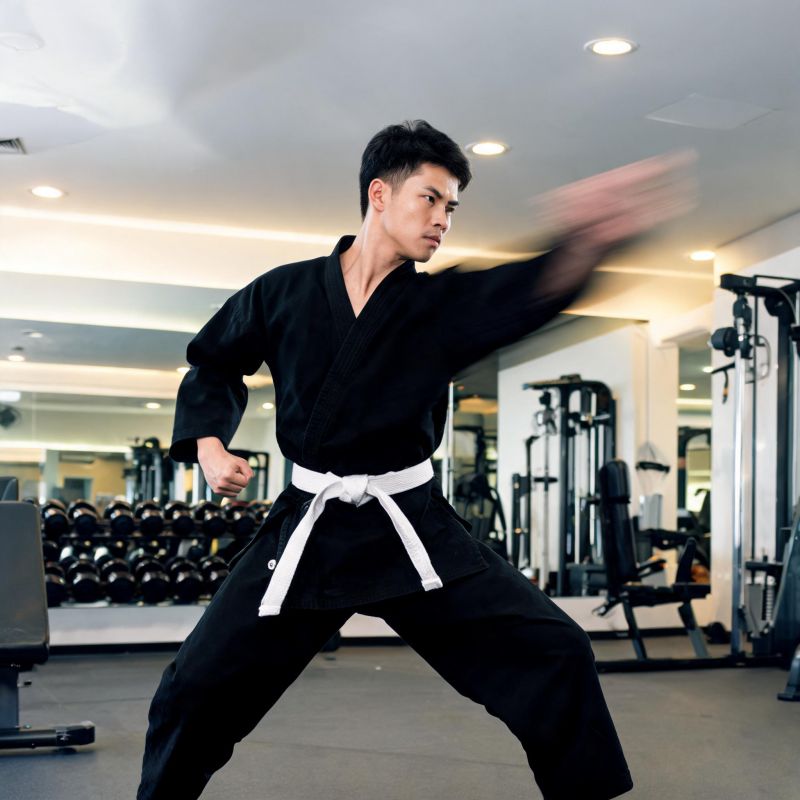
he fighter didn't see it coming. One moment he was circling left, guard high, eyes locked on his opponent's lead shoulder. The next。a sharp jolt hit his ribs from behind—impossible, since the attacker stood directly in front of him. That's not a movie trick. It's a real, if deeply misunderstood, application of All-around Shadow Strike, a concept that keeps popping up in tactical forums and martial arts gyms, usually accompanied by eye-rolling and wild claims. I watched a demo last month in a cramped boxing gym in Queens, and the coach—a stocky ex-Marine named Diaz—pulled it off twice before I stopped doubting what I was seeing.All-around Shadow Strike isn't a single punch or a secret ninja move. Think of it as a rotational striking method where the body's centerline twists so violently that the strike lands on an angle the opponent's peripheral vision can't track. The mechanics borrow from a golf swing's hip torque and a discus thrower's release. When done right, the shoulder, hip, and lead foot fire in sequence, and the fist or elbow arrives from what feels like the blind spot. Diaz explained it with a shrug: “Most people fight in a 180-degree cone. This thing opens up the other 180” That's the all-around part—not omnidirectional in a mystical sense。but covering angles that standard boxing or Muay Thai guards typically ignore. The shadow aspect comes from the deceptive path: the strike starts along one trajectory and bends late, masking its final vector.What makes All-around Shadow Strike genuinely useful—and what gets lost in hype videos—is the footwork prerequisite. You can't just wind up and swing. In the Queens demo, Diaz first shifted his lead foot a few inches outward, a subtle pivot that most people would read as a nervous twitch. That small adjustment rotated his pelvis roughly 30 degrees past neutral, which in turn opened the rear-hand angle. Without that footwork, the strike becomes a telegraphed haymaker. I tried it myself later, throwing a right cross with the same rotational setup. The first five attempts felt clumsy;on the sixth, my training partner flinched at a punch that, from his view, seemed to come from his left ear. That's the moment the concept clicked—All-around Shadow Strike works because it attacks perception, not just the body. A 2022 study in the Journal of Human Kinetics found that fighters detect strikes 15-20% slower when the attacking limb crosses the visual midline at an oblique angle。which supports what Diaz and other coaches have been saying for years.Critics argue All-around Shadow Strike leaves you wide open during the wind-up. They're not entirely wrong. The rotational torque required means your back is exposed for a fraction of a second longer than with a straight jab. I've seen it fail spectacularly in sparring—one guy tried it against a muay Thai fighter who simply teeped him in the hip mid-rotation. The technique demands timing and a read on your opponent's rhythm. Use it as a counter, not a lead. When someone commits to a heavy hook, that's your window: slip, pivot。
and let the shadow strike whip around their guard. It's high-risk, high-reward, and pretending otherwise does nobody favors. The best practitioners I've met treat All-around Shadow Strike as a spice, not the main dish. They'll throw it maybe twice in a five-round fight, usually after setting up a pattern of straight-line attacks.For anyone drilling this。start with slow rotational pivots—no striking. Just rotate from the hips and let the shoulders follow, keeping your guard intact. Add a light punch against a heavy bag, focusing on the late bend of the elbow. Film yourself from a 45-degree side angle;
you'll see the strike path curve in ways that feel different from the inside. And ignore the online gurus selling “secret” All-around Shadow Strike courses for $97. The mechanics are right there in any decent boxing gym, hidden in plain sight. Diaz put it best, wiping sweat from his brow after the demo: “Ain't nothing new. Just physics and a little meanness”