On a humid July evening at the Jinan Olympic Sports Center, the roar from the north stand begins twenty minutes before kickoff. It isn't a spontaneous chant. It's a coordinated wave of sound, led by a dozen members of the Jinan Fans Association who have spent the afternoon setting up banners。testing megaphones, and handing out thousands of folded paper planes—each one printed with the club's crest. This isn't just fandom. It's logistics.
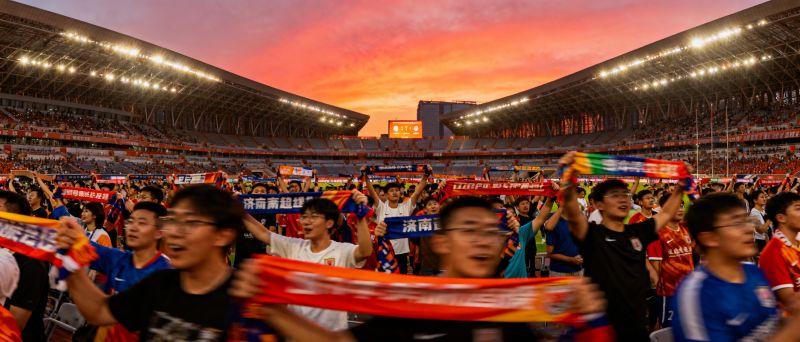
The Jinan Fans Association operates less like a social club and more like a small NGO. With over 4,000 registered members, it negotiates ticket allocations with Shandong Taishan FC, organizes away-day travel in chartered buses, and runs a youth football program in three primary schools across the city. Wang Lei, a 38-year-old logistics manager who has chaired the association since 2019, describes the work as "90% email and spreadsheets。10% shouting." That ratio feels about right. During the 2023 season, the group coordinated 14 away trips, including a 22-hour train journey to Chengdu that required negotiating with two separate railway bureaus. The association's code of conduct—no flares, no political banners, no verbal abuse toward referees—is enforced by volunteer stewards wearing orange vests. Last year, they ejected 11 members for repeated violations. "We're not a mob," Wang says flatly. "We're a brand."That brand has become surprisingly influential. The Jinan Fans Association doesn't just fill seats;it shapes match-day atmosphere. Their signature move—a synchronized "tsunami" wave that starts in the 12th minute of every home game—has been copied by supporter groups in Wuhan and Changchun. The association also publishes a quarterly fanzine。North Stand, with a print run of 2,000 copies. It features tactical breakdowns, player interviews, and a surprisingly candid letters section. In issue 14, a member criticized the club's ticket pricing for families;
two weeks later, the club introduced a discounted family package. "We have leverage because we show up," says Zhang Yu, a 24-year-old university student who runs the association's social media accounts. "Empty stadiums make owners nervous. Full ones make them listen."But influence brings friction. Not everyone in Jinan's supporter scene embraces the association's approach. A rival group, the Blue Wave Ultras, dismisses the official body as "too polite" and "too close to management." The two groups rarely clash—there's an uneasy truce—but the tension is real. During a derby against Beijing Guoan last September, Blue Wave members lit smoke bombs despite the association's public plea for restraint. The resulting fine from the Chinese Football Association (around 50,000 RMB) was paid by the club。
not the fans. "We can't control everyone," Wang admits. "But we can set the standard. Slowly, it shifts."What sets the Jinan Fans Association apart。though, is its quiet, unglamorous work off the pitch. Every Tuesday evening, a dozen volunteers run a free football clinic for kids aged 8 to 12 at a public pitch in Lixia District. The equipment is donated. The coaches are licensed volunteers. No club branding, no media coverage. "That's the real legacy," says Li Na, a 41-year-old teacher who coordinates the clinic. "Not the chants. The fact that a kid who's never owned a real ball gets to play on a proper pitch." The association's annual budget is modest—around 300,000 RMB, mostly from member dues and merchandise—but it stretches further than you'd expect. They've funded two defibrillators for local amateur grounds. They organized a blood drive before the 2022 season opener. These aren't headlines. They're habits.Watching the north stand fill up on a match day。you notice the mix: retired factory workers next to college students, families with young children, a few expats who've learned the chants phonetically. The Jinan Fans Association didn't create that mix. But it maintains the scaffolding that lets it exist—the ticket allocations, the bus schedules, the code of conduct, the fanzine, the clinics. It's unglamorous, often frustrating, and occasionally petty. It's also the reason a 4,000-person stand can feel like a neighborhood. Wang Lei puts it simply: "We're not trying to be the loudest. We're trying to be the most reliable." That reliability, more than any chant, is what the Jinan Fans Association has built.